What Are the Key Differences Between QM and Non-QM Loan Guidelines
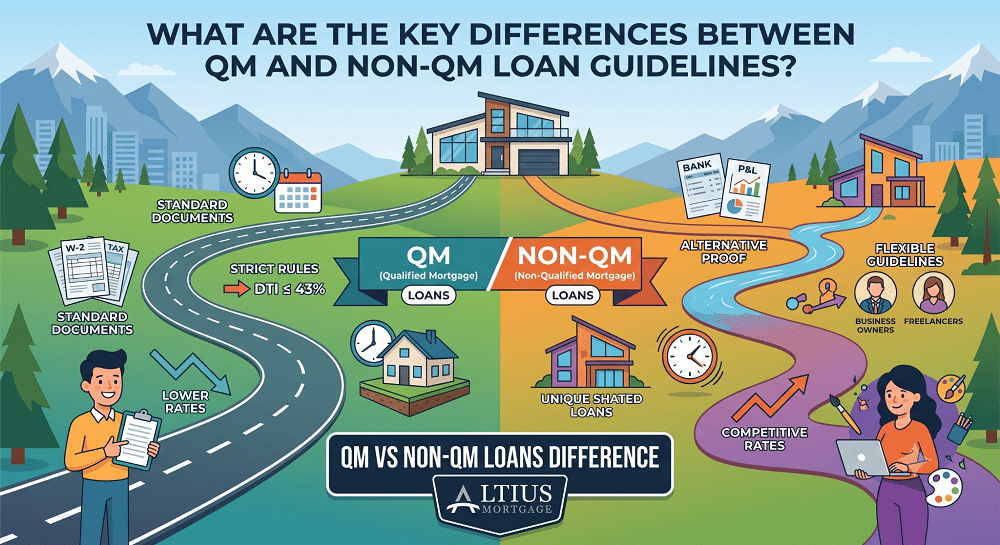
Navigating the mortgage market can feel like learning a new language, especially when lenders start throwing around industry acronyms. If you are looking to purchase a home or refinance in Draper, Utah, you need financing that actually aligns with how you earn your living. At Altius Mortgage, one of the most common questions we receive from homebuyers centers around the QM vs non-QM loans difference and how it impacts their approval odds.
For decades, the mortgage industry forced everyone into the same rigid financial box. Today, the landscape is much more accommodating. Understanding whether you need a Qualified Mortgage (QM) or a Non-Qualified Mortgage (Non-QM) is the first step toward securing the keys to your new home. Here is a breakdown of the key differences in guidelines, documentation, and costs.
1. Defining the Standards: Regulatory Rules vs. Flexible Lending
The primary difference between these two loan categories comes down to federal regulation and underwriting strictness.
Qualified Mortgages (QM) are traditional loans that meet strict federal standards established by the Consumer Financial Protection Bureau (CFPB). These guidelines are designed to create a highly predictable, low-risk lending environment. QM loans cannot feature “risky” mechanisms like balloon payments, negative amortization, or extended interest-only periods, and they generally require your debt-to-income (DTI) ratio to stay at or below 43%. Conventional loans backed by Fannie Mae and Freddie Mac are all QM loans.
Non-Qualified Mortgages (Non-QM) are loans that deliberately operate outside of these rigid CFPB constraints. However, “Non-QM” does not mean unregulated or predatory. Under the Dodd-Frank Act, lenders are still legally required to verify your Ability-to-Repay (ATR). A Non-QM loan simply provides the lender with the flexibility to use alternative methods to prove that you can comfortably afford the mortgage.
2. Documentation Differences: Standard Tax Returns vs. Alternative Proof
The most noticeable difference you will experience during the application process is the paperwork required to get approved.
If you are applying for a QM loan, the underwriting process relies heavily on traditional tax documentation. You will need to provide:
- W-2 forms from the past two years
- Recent pay stubs (usually covering the last 30 days)
- Two years of consistent, filed tax returns
For a Non-QM loan, lenders look at the reality of your cash flow rather than what you report to the IRS. Because business owners often take aggressive legal tax write-offs, their tax returns rarely reflect their actual purchasing power. Non-QM loans bypass this issue by accepting alternative proof of income, such as:
- 12 to 24 months of personal or business bank statements
- Profit and Loss (P&L) statements
- 1099 forms
- Asset depletion (using a large liquid portfolio to calculate a monthly income equivalent)
- Debt-Service Coverage Ratio (DSCR), which qualifies real estate investors based entirely on the rental income the property generates
3. Borrower Profiles: Who Fits Which Loan Best?
Because the underwriting rules are so different, QM and Non-QM loans serve distinct types of buyers.
| Feature | QM Loan | Non-QM Loan |
| Ideal Borrower | Salaried employees with standard W-2s | Self-employed, freelancers, gig workers |
| Real Estate Investors | Limited to 10 financed properties | Unlimited properties using DSCR loans |
| Retirees | Need documented pension/social security | Can qualify using high asset reserves |
| Income Verification | Tax returns and W-2s | Bank statements, 1099s, or P&L |
If you work a traditional 9-to-5 job, have a straightforward salary, and possess a healthy credit score, a QM loan is almost certainly your best route. If you are an entrepreneur, a freelancer with variable project-based income, or an investor with a complex portfolio, a Non-QM loan is built specifically for you.
4. Risk and Interest Rates: Flexibility Comes at a Cost
In the mortgage world, interest rates are directly tied to risk and market liquidity.
Because QM loans fit perfectly into the strict underwriting boxes created by the government, lenders can easily sell these mortgages on the secondary market to entities like Fannie Mae and Freddie Mac. This high liquidity and low presumed risk allow lenders to offer QM loans at the lowest interest rates available on the market.
Non-QM loans cannot be sold to these government-backed agencies. Because lenders have to keep these loans on their own books or sell them to private investors, they take on slightly more perceived risk. To compensate for this risk—and for the extra manual labor required to underwrite complex bank statements—Non-QM loans typically carry higher interest rates and may require a slightly larger down payment. However, for many business owners, paying a slightly higher rate is a worthwhile tradeoff to secure a home without having to alter their tax strategies.
Contact Altius Mortgage in Draper, UT
Understanding the nuances of the mortgage market shouldn’t be a journey you take alone. Whether your financial profile perfectly fits the traditional QM box or you need the creative flexibility of a Non-QM loan, our team is here to guide you.
At Altius Mortgage, we specialize in matching Utah residents with the exact loan product that fits their life, business, and goals. Contact us today to learn more about our services!
